Thursday, January 6, 2011

2010 CoLAB for UF Freshman Honors Students


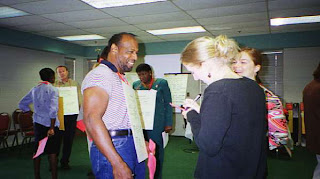
This session's goal was to introduce students to each other and demonstrate the potential for future friendships and partnerships on class projects. All these students plan to pursue doctoral degrees in the sciences.

Here's some comments from the students:
As an introvert, I was surprised by how easily I was able to begin conversations with people I had never met before and even want to continue talking past the three minute mark. It was really an effective method of breaking the ice and getting to meet your peers.

"Through the session, I was able to get to know my classmates and learn about their research interests, majors, and hobbies. It was a great way to get to know their names and start open conversation with them.

I also got to see who had similar research interests as myself. It would be great to collaborate or work with them in the future in looking for opportunities and in working on research topics.

I also realized that many of my classmates were in the same boat as me with the lack of research experience, and it made me feel better about the lack of experience I have."

I learned a lot about my fellow students. Most people in this class are interested in the sciences, particularly the fields of biology and chemistry.. Most students also seem to be on the pre-professional tract. I think a lot of students see the class as an opportunity to get involved in research. Though most conversations were about the general questions such as your major and classes you are taking, there was other topics that were more fun and carefree.

I was surprised by how curious others were about me. I thought the meeting would be awkward, but it turned out to be a great session. People were asking me all sorts of questions after reading my info card. Likewise, I was more engaged after being asked so many questions and started asking plenty of questions myself.

UF Women in Science & Engineering CoLAB 2010


The goal of this session was to understand the basics of collaboration development towards the objective of identifying a faculty mentor in science or engineering. 15 students and 15 faculty participated.

Here are some comments from faculty:
I was impressed with Bess' introduction. Specifcially the levels of risk one is will to take to interact with others. I think she hit the nail on the head. To successfully collaborate, the partners must be willing to change behavior for the potential of a successful venture. I also liked the discussion of assets. This pre-discussion is/was particularly important for our young scientists.

The actual interactions between students and faculty were fun and it was striking the similarities that were written on our placards, despite significant age/experience differences. I really enjoyed meeting the students and pleased that we have such motivated young women.

We certainly met new people (one of the objectives), but it is not clear that the students identified new mentors. Our interests were quite varied. On the other hand, the faculty regardless of discipline should have a lot of experience that they could pass on. Perhaps time will tell.

I learned that there must be some inherent and common drive in women who enter science.

And from a student:
I recommend future CoLab can offer us more opportunities to talk with grad students, so that we can not only find something interesting in our academic work, but also can we broaden our social network:)

University of Florida: 2010 Collaboration Basics in Grant Seeking


I was invited to present this lecture to Ph.D. students in a grant writing course taught by Dr. Jared Daniels, in the Entomology Dept. For most students, this class was their first foray into grant seeking. Most didn't know each other--it was a multi-disciplinary group including science, health, math, and the arts/humanities majors.

The goal of the lecture was to help students understand components of outstanding collaborations, why collaborations fail, and how to learn about others' assets which is the basic tool for developing collaborative relationships.

Florida State University: Open Access Statewide Conference CoLAB 2010


The goal of this statewide conference was to present the most current information regarding copyright law and ways to inspire academics to publish in open access journals.

The problem was attendees largely didn't know each other's work in the field of open access. CoLAB speed meeting processes facilitated by Bess de Farber, created a knowledgeable framework about available assets in this topic area, from which collaborations and shared support could grow.

For the second part of CoLAB Planning ® the group divided into 8 “idea” tables, ensuring a diversity of institutional representatives at each table. First, participants exchanged information about their own institution’s strengths, weaknesses, opportunities and threats as they relate to Open Access issues. Within a 10 minute timeframe, participants at each table brainstormed as many possible ideas for moving Open Access forward on their campuses and state-wide. As they brainstormed, librarians recorded their ideas on post-it notes. The results in this preliminary report come from the post-its created during the Idea Tables process.

Major themes to emerge:
This preliminary report categorizes the 204 suggestions given by workshop attendees into 12 major themes. The structure of this report lists the theme, a definition of that theme, and all the suggestions relevant to that theme. 84 suggestions fit into multiple themes and therefore are listed multiple times.
Because this was a brainstorming activity, no ideas have been excluded from this preliminary report.

# of suggestions Theme
77 Engage in faculty outreach
40 Market/ Develop PR for Open Access
34 Strategic planning for Open Access initiatives at the campus and state level
33 Improve Institutional Repositories & digital collections
33 Continue librarian education/ promote librarian awareness
32 Develop workshops on scholarly communication; integrate scholarly communication into existing instruction efforts
15 Get support from/ work with administration (both librarian and campus)
11 Engage in student outreach
9 Librarians should publish in Open Access journals
7 Conduct environmental scans or assessments
6 Develop Open Access Journals hosted by/ managed by libraries
6 Create strategies for working with/ responding to publishers/vendors

TABLE 1: Suggestion Themes
As a follow up to the CoLab Planning ®, all participants will be sent the list of suggestions generated at the event. A webpage will be developed for participants to comment on suggestions, share new suggestions, and continue the conversation thus extending the workshop experience.

Friday, November 27, 2009

CoLAB Session: UF College of Fine Arts 2009


Another experiment! The UF College of Fine Arts wanted to present a CoLAB session for their faculty in the 3 schools: Music, Theatre/Dance/Design and Visual Arts. The problem was lack of time. I was appropriated 1:30 minutes in which to make this happen: signs were ready but participants had to insert their personal answers to questions about their personal passion, their skills and future recommendations for changes with the school, college or UF systems.

We've got a lot of great photos (shot by Barbara Hood of this facilitated process. The location was a renovated women's gym at UF that presented natural light and two floors with a useful ledge around the balcony for preparing signs. Approximately 100 participated and were able to have 10 focused conversations with colleagues from schools different from their own. Although faculty were extremely skeptical about the process, it was a huge success. The Dean Emeritus, Dr. Donald McGlothlin commented, the college "had tried many times to create a networking environment, but this was by far the most successful of all previous attempts." The process was so successful that some faculty are using it to help graduate students connect with each other's passions and assets.

CoLAB Session: Broward Community Foundation Summer 2008

WOW, two sessions for the Broward Community Foundation, with Kimberly Sovinski assisting were a tremendous effort. More than 60 participants attended and were divided into to groups: 8:00 to 12:00 and 1: 00 to 5:00. We managed to allow folks to move through enough rounds that they were able to have CoLAB discussions with nearly everyone. It was truly a Herculean effort by the CF staff and the results were excellent. Participants reactions have been consistent: they cannot believe how much they don't know about each other, the community, and the available resources.

CoLAB Session: Living the Future Conference April 2008

This was definitely an experimental session. The theme of the conference, Transforming Libraries through Collaboration, drew over 150 from throughout the country, both academic library professionals and Tucson fans of Peter Senge, the keynote speaker.

The goal of this CoLAB session was to help conference attendees quickly connect with each other by learning about the assets they each possessed. It was facilitated after the keynote during the first day of the session and ran for a couple of hours.

The result was a conference unlike any other. The energy was high throughout and attendees enjoyed the "open-access" environment that permitted very open discussions without the usual inhibitions of conferences where it's a lot of work to connect with those you don't know. The CoLAB session somehow gave folks "permission" to connect and reduced the distance between "strangers."

Friday, January 25, 2008

Living the Future Conference 2008


I am happy to announce that CoLAB processes will be used for the first time in a very large group format on day one, May 1st of this outstanding library conference, in Tucson, AZ. Following the keynote address by Peter Senge, Ph.D. and the father of organizational learning, I will facilitate a giant CoLAB session for all conference participants. Our goal is for attendees to connect in a strong way to the available skills and assets available at the conference.

If you've been to a conference and didn't get to REALLY connect with people then you know how important a structured networking session can be. Especially if 150+ people all are interested in the same subject: Transforming Libraries through Collaboration!

To learn more about the conference tracks and presenters, go to www.library.arizona.edu/conference/2008/

Thursday, September 6, 2007

Future CoLAB Planning Sessions in the works

The University of Arizona Libraries - Science and Engineering Librarians are planning to present a CoLAB session for BIO5 faculty researchers this fall. Librarians have applied for human subjects approval to measure the success of CoLAB's networking process in terms of its effectiveness in eliminating barriers to collaborative thinking and future project ideas. This will provide the first true research results by measuring pre- and post attitudes towards collaborative potential among science faculty who may discover interdisciplinary connections with each other. I'll let you know what happens!

About BIO5: Launched with funds from a voter-approved tax in 2001, BIO5 is designed to fuel economic development by pursuing state-of-the-art biological research, by creating new products and processes, by encouraging productive research interactions between faculty and industrial scientists, by training a bioindustry workforce and enhancing science literacy

Friday, August 10, 2007

CoLAB: University of Arizona Bio5 2008


The University of Arizona Libraries staff and Bess de Farber facilitated a session to connect 17 researchers to each other's assets during a 3 hour CoLAB session. The positive results were presented at the 2008 ALA conference poster session that demonstrated a possible new role for academic libraries: organizing information about a specific group's assets (articles, research, networks, etc.)

Sunday, August 5, 2007

Communities of Practice - Origin

" ... small group of people who've worked together over a period of time. Not a team, not a task force, not necessarily an authorized or identified group. They are peers in the execution of "real work." What holds them together is a common sense of purpose and a real need to know what each other knows."

* The term "Community of Practice" was coined by John Seely Brown of the Xerox PARC (Palo Alto Research Center) back in the 1980s.

Communities of Practice Quote

"It is probably true quite generally that in the history of human thinking the most fruitful developments frequently take place at those points where two different lines of thought meet. These lines may have their roots in quite different parts of human culture, in different times or different cultural environments or different religiouse traditions: hence if they actually meet, that is, if they are at least so much related to each other that a real interaction can take place, then one may hope that new and interesting developments may follow." Werner Heisenberg

Saturday, August 4, 2007

CoLAB Planning in the Glades


The Glades CoLAB held in Belle Glade, FL was pretty special. It brought participating organizations together that traditionally work in the Glades and those that wanted to extend their services to Glades residents through potential partnerships. CoLAB was so well received because it focused on the assets of organizations rather than gaps. Unfortunately, the Glades communities have been known for what they don't have like a movie theatre. But during our sessions together we mostly focused on what the Glades has to offer, and by combining these assets, determining how goals can be accomplished in new ways.

CoLAB Planning for SDKE: Sonoran Desert Knowledge Exchange


You can't believe how many people and organizations are working on advocating, educating, researching and sustaining the Sonoran Desert in Arizona and Mexico. The University of Arizona Libraries brought some of these folks together to explore the possibilities of connections and leveraging of assets.

It doesn't matter where we live or the subject of our life's work: creating communities of practice is the wave of the future for a variety of reasons. We have more information than ever before, but we are missing the in-person connection that gives us quick real-time information and an indication of mutual interest. If I had all the time in the world, I'd just be interested in interviewing people about their passions, interests, learnings, wisdom, assets, networks, and more. I'm wondering if all of this information is making us more isolated? The conversations are what spark creativity, especially if you have the right people in the room. These are the one's who self-select participation. If they show up, then that's the first step toward discovering the hidden potential in the room and community!

CoLAB Planning Team Collaboration Activity


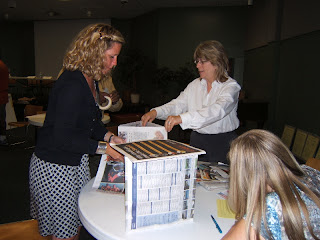
What you see in these images is the team building activity that requires CoLAB participants to build a newspaper sculpture. One of the participants on the team observes and takes notes. This activity illustrates how participants choose to plan or not, communicate or not, laugh or not, work or not, etc. These choices are then analyzed in comparison to the production of the sculpture. You have to remember, these folks have never worked together in this way. They may know each other but by working in this activity, collaboration theories must be applied to be successful. Needless to say, this was a BLAST! The energy was focused and productive. We learned so much about how different people approach a challenge based on the combination of assets at the table, communication and planning processes.

Wednesday, August 1, 2007

CoLAB for University of Arizona Libraries 2006


This was an experiment to determine if positive results could be generated from running a CoLAB Planning Series within a large organization. It worked! You can tell from the expressions that staff enjoyed learning more about each other; especially those who don't work together. The UAL has 165 employees so you can imagine that there isn't a lot free time to get to know people as this task seems so overwhelming.

CoLAB Planning for Martin County Literacy 2005


CoLAB for Martin County Literacy was really a treat. ASK presented a series of 3 workshops with all kinds of different folks interested in improving literacy within the county. We police officers, correction officers, government officials, school and industry representatives, and nonprofit organizations staff and volunteers. The result was the establishment of an actual Coalition charged to develop some of the ideas that came out of this session. United Way of Martin County was the CoLAB Planning sponsor. Everyone felt they walked away with concrete results.

Sunday, July 29, 2007

Website with Information about CoLAB Planning, facilitation, nonprofit management, grants and other services

Take a look at the CoLAB Planning button on the AskBess.net site to see a brief description of the CoLAB Planning Series process and philosophy. Please let me know if you have questions. It is a fun and challenging process where people learn a lot of USEFUL information about each other!

CoLAB Planning Boca Raton + Florida Atlantic University + Jr. League of Boca


These CoLAB Planning workshop participants are engaged in an idea table exercise to mine ideas that are based on existing assets within the organizations represented: Nonprofit Resource Institute (Community Foundation for Palm Beach & Martin Counties); Palm Beach County Resource Center; and the Jr. League of Boca Raton.

CoLAB Planning Broward County 2007


Participants network with each other using a speed dating method that connects people to resources in a large group facilitated process created by Bess de Farber.